Help Shape Niagara Falls’ Housing Incentive Program
As part of the City’s Community Improvement Plan (CIP), Niagara Falls is developing a Housing Incentive Program to help support the creation of more affordable and attainable housing in our community.
Community Improvement Plans allow municipalities to offer financial incentives that encourage investment and help address local priorities. Through this program, the City is exploring incentives to support new housing development and help address barriers to the delivery of affordable, attainable homes in Niagara Falls.
Through public and stakeholder engagement, we are seeking feedback on:
- What incentives could help increase housing supply
- What barriers developers or housing providers face
- What tools could support the creation of affordable and attainable housing program options will be presented at an upcoming Public Open House and through meetings with stakeholders.
Your input will help guide the development of the final program.
What Can Affordable/Attainable Housing CIP Incentives Do?
Housing incentives delivered through a Community Improvement Plan (CIP) can support housing development in several ways.
They can:
- CIPs can be used to incentivize housing types where there is limited market interest or delivery capacity, such as housing for low- and moderate-income workers.
- CIPs can aid in the construction of housing by supporting project viability, for transitional, supportive, and deeply affordable units, that require operating funding beyond the CIP to make them viable.
- CIPs can help reduce early-stage and up-front development costs, lowering financial risk for both non-profit and for-profit developers.
- CIPs demonstrate local municipal commitment to Provincial and Federal funders. This “skin in the game” can be leveraged by housing providers and developers to attract additional investment.
It is important to note that while housing incentives can support development, they are only one tool among many. A Housing CIP alone will not solve all housing challenges, but it can play an important role as part of a broader housing strategy.
How This Fits With Other Housing Strategies
The City of Niagara Falls is pursuing several complementary strategies to support housing in the community.
The proposed Housing Incentive Program will work alongside other local, regional, and provincial initiatives to support:
- Market housing
- Affordable housing
- Community housing
Programs may also support transitional and supportive housing projects, where eligible.
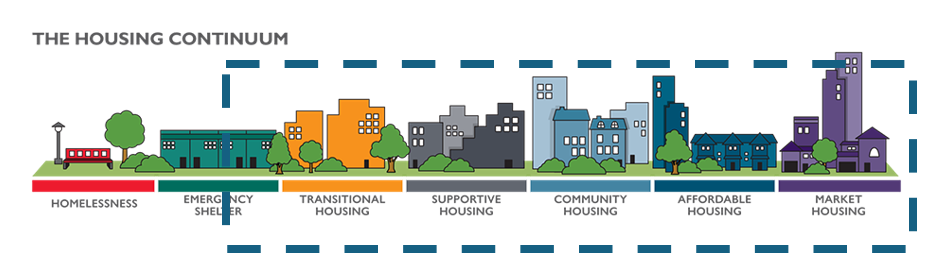 Source: Canada Mortgage & Housing Corporation, About Affordable Housing in Canada
What types of incentive programs is the city considering?
Please refer to the March 24, 2026, Open House Presentation Boards for information on these draft program options. Please provide your comments on the draft program options provided below:
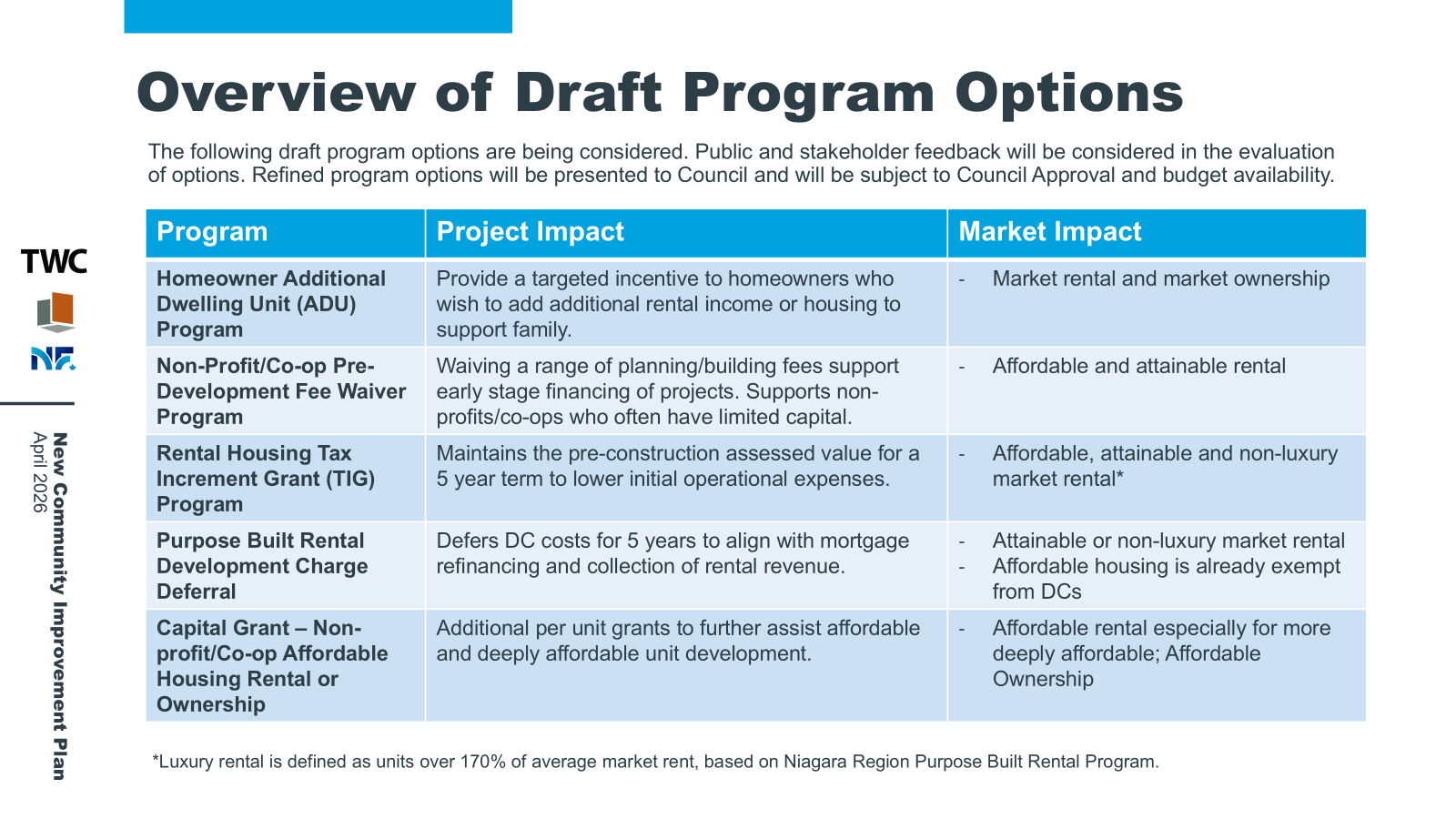
Overview of Draft Program Options
The following draft program options are being considered. Public and stakeholder feedback will be considered in evaluating options. Refined program options will be presented to Council and will be subject to Council Approval and budget availability.
Program | Project Impact | Market Impact |
|---|---|---|
| Homeowner Additional Dwelling Unit (ADU) Program | Provide a targeted incentive to homeowners who wish to add additional rental income or housing to support family. | Market rental and market ownership. |
| Non-Profit/Co-op Pre-Development Fee Waiver Program | Waiving a range of planning/building fees supports early-stage financing of projects. Supports non-profits/co-ops that often have limited capital. | Affordable and attainable rental. |
| Rental Housing Tax Increment Grant (TIG) Program | Maintains the pre-construction assessed value for a 5-year term to lower initial operational expenses. | Affordable, attainable and non-luxury market rental.* |
| Purpose Built Rental Development Charge Deferral Program | Defers DC costs for 5 years to align with mortgage refinancing and rental revenue collection. | Attainable or non-luxury market rental (affordable housing is already exempt from DCs). |
| Capital Grant – Non-profit/Co-op, Affordable Housing Rental, or Ownership Program | Additional per-unit grants to further assist affordable and deeply affordable unit development. | Affordable rental (especially for more deeply affordable) and affordable ownership. |
*Luxury rental is defined as units over 170% of the average market rent, based on the Niagara Region Purpose Built Rental Program.
Different organizations use different definitions of housing affordability. To provide clarity for developers and housing providers, the City aligns with Niagara Region and Provincial definitions using Average Market Rent (AMR) as a benchmark.
There are multiple definitions of affordability used across municipalities, governments and funders
- CMHC Rental Market Survey
- Development Charge Bulletin
- Local income-based calculations
The table shown here aligns with the Province and Niagara Region & provide clarity for developers and housing operators.
| Unit Size | Affordable (<100% AMR) | Attainable (100–125% AMR) | Market (126–170% AMR) |
|---|---|---|---|
| Studio | $1,005 | $1,256 | $1,709 |
| 1-Bedroom | $1,203 | $1,504 | $2,045 |
| 2-Bedroom | $1,395 | $1,744 | $2,371 |
| 3-Bedroom+ | $1,438 | $1,798 | $2,445 |
Sources: Data for Niagara Falls, Affordable Residential Units for the Purposes of the Development Charges Act, 1997
Under the Niagara Region’s definition:
- Affordable housing rents for less than 100% of the Average Market Rent
- Attainable housing rents for 100–125% of Average Market Rent
- Market housing typically falls above this rang
Affordable purchase prices are also defined under the Development Charges Act.
Current benchmarks for Niagara Falls are:
| Housing Type | Average Purchase Price |
|---|---|
| Affordable Purchase Price (all unit types) | $326,400 |
| Detached House | $730,000 |
| Row / Townhouse | $610,000 |
| Condo | $490,000 |
Sources: Data for Niagara Falls, Affordable Residential Units for the Purposes of the Development Charges Act, 1997 Bulletin
These benchmarks help guide programs that support affordable homeownership opportunities.